The problem with generic targets
Most nutrition apps use a single set of recommended daily values — the same ones printed on food labels. These are based on a 2,000-calorie diet for a generic adult. They don't account for your age, sex, body weight, lean mass, activity level, or whether you're pregnant or breastfeeding.
The result? A 22-year-old female athlete and a 55-year-old sedentary male get the same protein target, the same iron target, the same vitamin D target. That's not personalization — it's a lookup table.
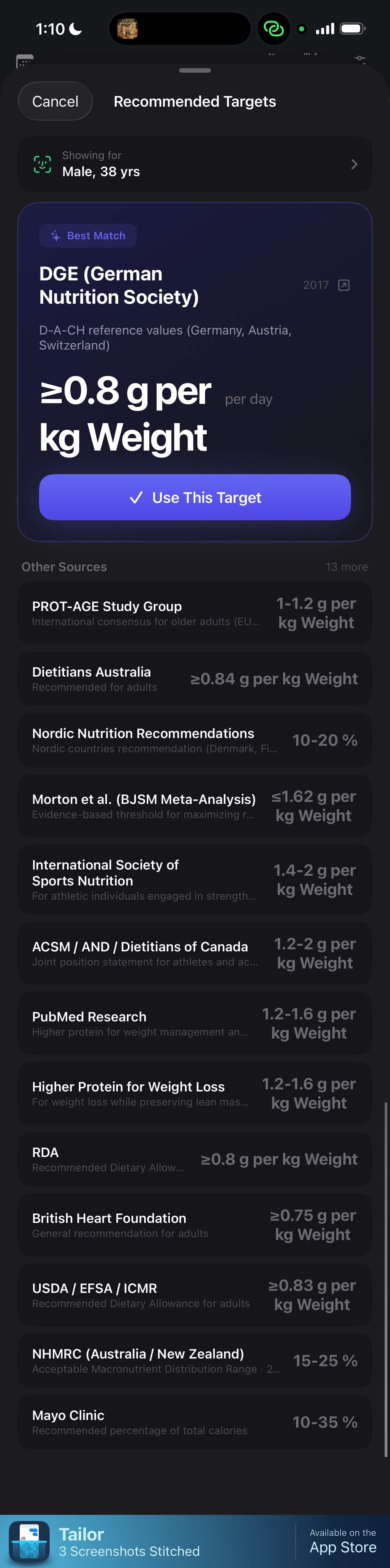
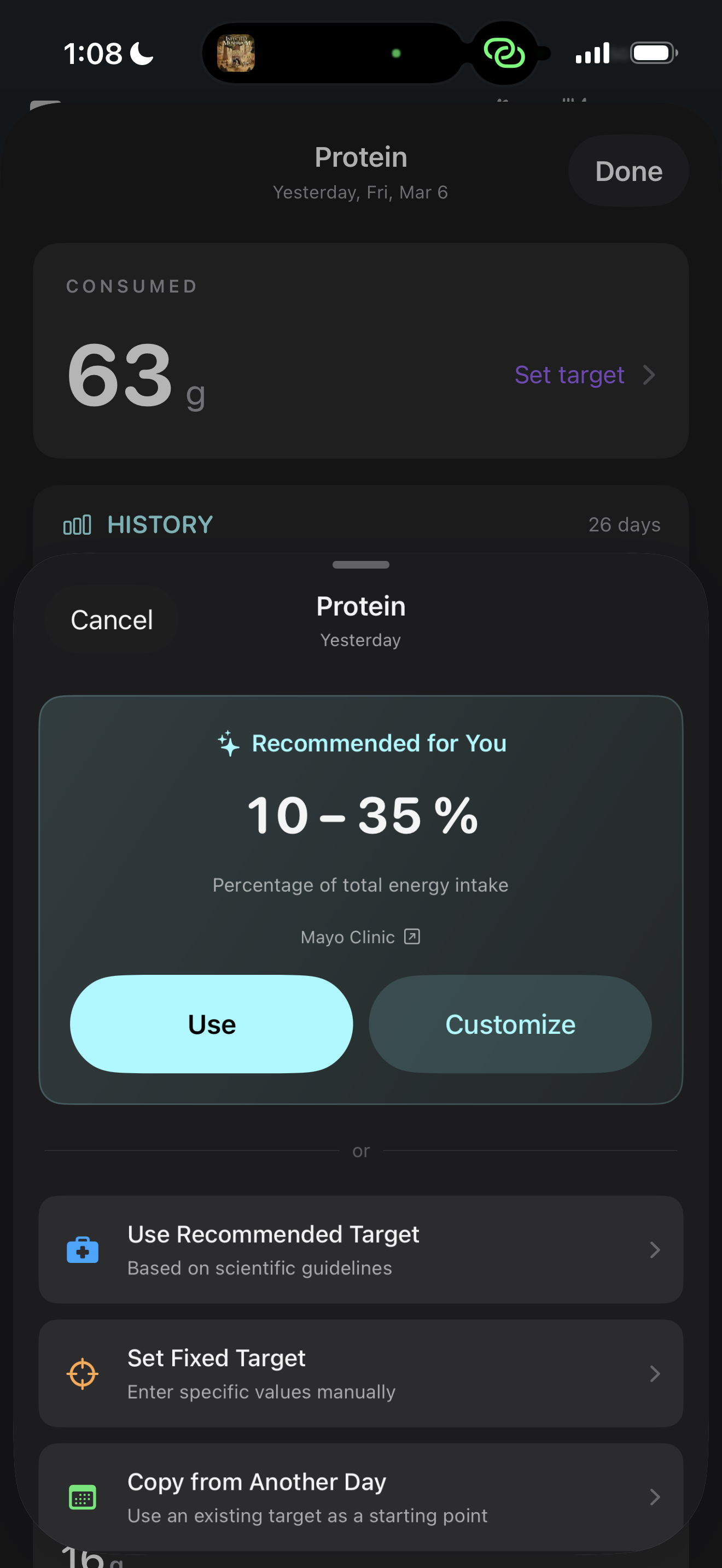
NutriKit takes a fundamentally different approach. Instead of one fixed number per nutrient, it calculates a recommended range — a lower bound and an upper bound — using the best available evidence for your specific profile. And every recommendation shows its source, so you always know where the numbers come from.
How your targets are calculated
When you set up NutriKit, you provide your biological sex, date of birth, body weight, and optionally your body fat percentage or lean body mass. If you're pregnant or breastfeeding, that's captured too.
From these inputs, NutriKit calculates personalized targets for every tracked nutrient. The calculation isn't a simple formula — it's a decision tree that selects the right recommendation source for each nutrient based on your profile.
The scientific sources
NutriKit doesn't rely on a single recommendation framework. Different nutrients have different best sources. For some, the Institute of Medicine's Dietary Reference Intakes (DRIs) are the gold standard. For others, the World Health Organization, the European Food Safety Authority, or recent meta-analyses provide better, more current guidance.
Every recommendation in NutriKit cites its source — so you can verify exactly where your targets come from.
Here's how the source selection works for key nutrient categories:
Protein
The generic RDA for protein is 0.8 g/kg — a value established to prevent deficiency, not to optimize health or body composition. NutriKit uses a more nuanced approach:
- Base recommendation scales with body weight (not a flat number)
- If lean body mass is available, the calculation uses that instead — giving more accurate targets for people with higher or lower body fat
- Age-adjusted: adults over 65 get a higher per-kg recommendation based on research showing increased protein needs in aging populations
- Pregnancy and breastfeeding adjustments are additive on top of the base calculation
- The upper bound is informed by the literature on the maximum beneficial intake — beyond which additional protein shows diminishing returns
The result is a range like 95–155g rather than a single “46g” that ignores your weight entirely.
Vitamins & Minerals
For micronutrients — vitamins A, C, D, E, K, and the B-complex, plus minerals like iron, calcium, zinc, magnesium, and potassium — NutriKit pulls from the IOM Dietary Reference Intakes, cross-referenced with EFSA and WHO guidelines where they diverge.
Each micronutrient target is adjusted for:
- Age bracket (the DRIs define different values for 19–30, 31–50, 51–70, and 70+)
- Sex (iron requirements differ dramatically between males and pre/post-menopausal females)
- Pregnancy trimester and lactation status
- Tolerable Upper Intake Levels (ULs) form the upper bound — these are the amounts above which adverse effects become more likely
For nutrients where the science is evolving — like vitamin D, where many researchers argue the current RDA of 600 IU is too low — NutriKit's range reflects the broader evidence base, not just the most conservative guideline.
Fats & Fatty Acids
Total fat, saturated fat, monounsaturated fat, polyunsaturated fat, omega-3, and omega-6 all get separate targets.
- Total fat range is calculated as a percentage of your calorie target (typically 20–35% of calories), converted to grams
- Saturated fat upper bound follows the American Heart Association guideline of <10% of calories
- Omega-3 (ALA, EPA, DHA) targets use the IOM Adequate Intake plus supplemental guidance from the AHA for cardiovascular benefit
- The balance between omega-6 and omega-3 is considered — NutriKit flags when your ratio is heavily skewed
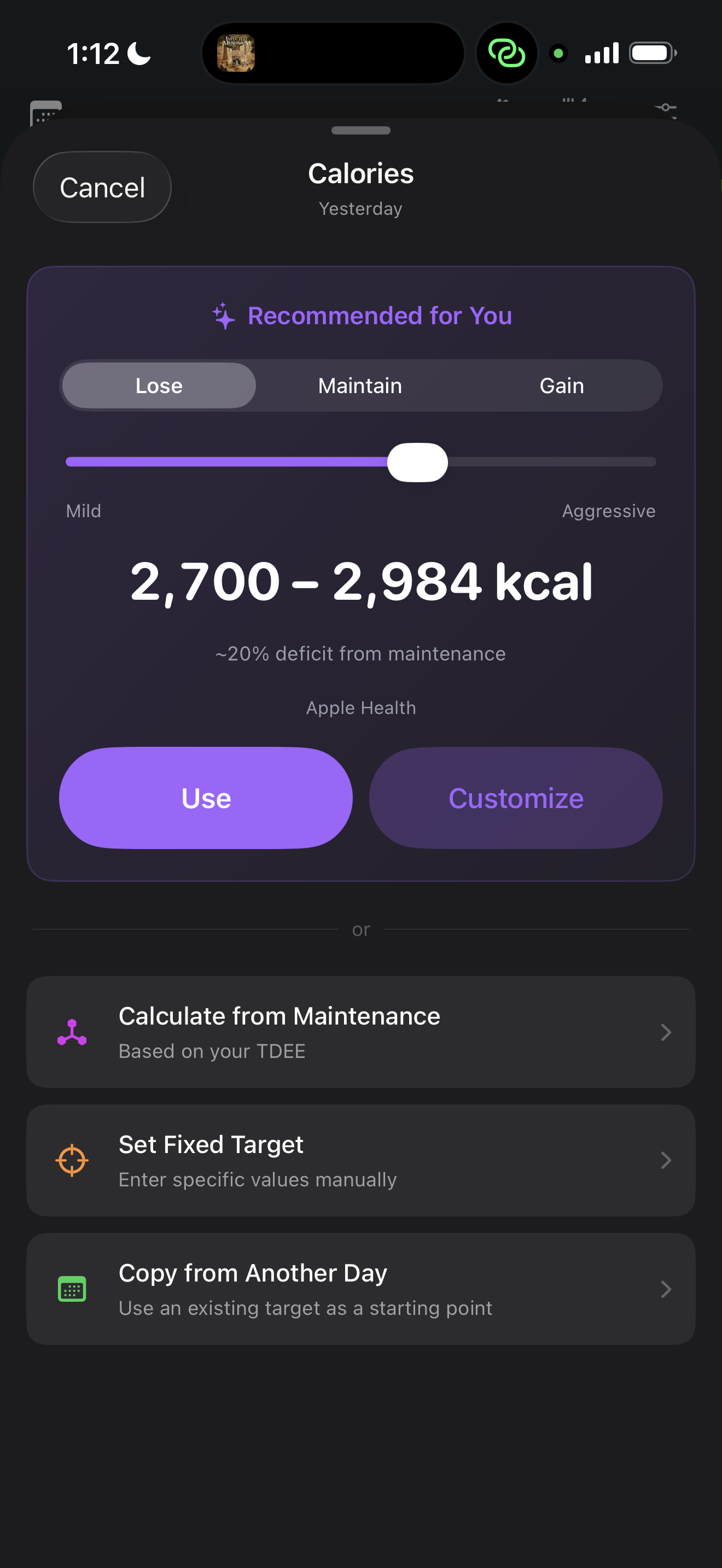
Because fat targets depend on your calorie target, they automatically update when your calories change — whether from a manual adjustment, a taper, or a recalculation from the energy balance algorithm.
Carbohydrates & Fiber
Carbohydrate targets are derived from your calorie and fat/protein targets — they fill the remaining caloric budget. This means carb targets are always internally consistent with your other macros.
Fiber gets its own independent target based on the IOM Adequate Intake: 14g per 1,000 calories consumed, with age and sex adjustments. Added sugar has an upper bound based on WHO and AHA guidelines (typically <10% of calories, with a stricter <6% option available).
Why ranges, not single numbers
A single target number creates a pass/fail dynamic. You either hit it or you didn't. This leads to unnecessary stress and doesn't reflect nutritional reality — your body doesn't have a cliff at exactly 46g of protein.
Ranges are more honest. The lower bound represents the minimum for preventing deficiency and supporting basic function. The upper bound represents either the point of diminishing returns or the tolerable upper limit.
Anywhere within the range is good. NutriKit's dashboard shows your intake as a position within this range — green when you're inside it, with clear visual feedback when you're below or above.
Full control when you want it
Smart Targets are the default — but you're never locked in. Every nutrient target can be manually overridden. Set a custom lower bound, upper bound, or both. Your override persists until you clear it, at which point the calculated value returns.
This is useful for athletes following specific macro protocols, people with medical dietary restrictions, or anyone who's received guidance from a dietitian that differs from the general population recommendations.
When you override a target, NutriKit shows it with a distinct indicator so you always know which targets are calculated and which are custom.